Character art for books is becoming an increasingly interesting part of how stories are discovered nowadays. For most of publishing history, though, readers have had to do the visual heavy lifting themselves.
The author describes the heroine. You build her face in your head. Dark hair, crooked smile, whatever the author gives you, your brain takes it from there. Sometimes you get a crystal-clear picture. Sometimes you get something closer to a blurry Sims character. That gap is part of the magic. Fiction has always left room for the reader’s imagination.
There’s another reason novels have traditionally been so light on art: it used to be expensive and technically awkward to put pictures into books. For much of publishing history, illustrations required separate engraving or printing processes, extra labour and additional production costs.
Illustrated fiction absolutely existed - the 19th century saw plenty of it, with Dickens and others helping make illustrated novels commercially successful. But by the 20th century, illustrations had largely disappeared from adult novels, while covers remained one of the main places where publishers could use visual art to sell the book.
Now, the pendulum is swinging back. In an unprecedentedly saturated publishing landscape, contemporary authors must cultivate distinctive avenues of differentiation; anchoring a narrative with a visually unforgettable protagonist provides a compelling focal point for reader engagement.
Start With Your Characters
A well-written character can become incredibly vivid without a single illustration. You know the type. You read three chapters and somehow you already have a face in your head, a voice, a particular way they stand, maybe even an outfit you’ve completely invented without the author ever describing it.
Character art can reinforce that mental picture - or turn it on its head. It can establish a character’s appearance, but it can also communicate personality, history, status, culture and relationships. Clothing can reveal where someone comes from. A posture can say more about confidence than three paragraphs of exposition.
Sometimes the most useful thing an illustration does is simply make a character recognizable. That matters especially for readers that eat 10 books within the same trope in a month.
What is Character Art For Books?
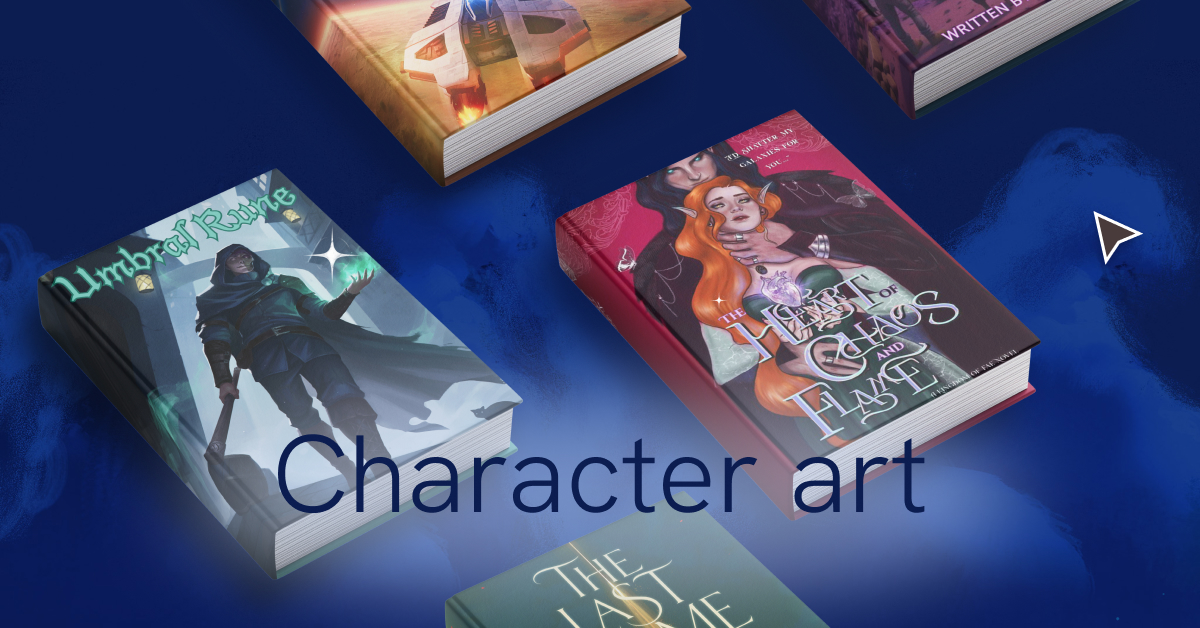
Character art for books can mean almost anything that gives a fictional character a visual form. It might be a detailed portrait showing exactly what a protagonist looks like. It might be a full-body illustration showing their clothing, posture and physicality. It might be a rough sketch. A character sheet. Several expressions. Different outfits. A scene showing two characters together. An illustration of the object they always carry.
It could even be something much less literal. A character doesn’t necessarily need to be presented standing against a blank background like they’re applying for a passport. The format should follow the character and the story.
A mysterious character might work better when you only see their silhouette. A romance protagonist might benefit from several expressions and outfits. A fantasy creature might need a detailed reference showing anatomy and markings. A historical character might be defined as much by clothing and environment as by their face.
There is no single definition of character art for books. That’s part of the fun.
Character Art For Books Works Across Every Genre
Fantasy authors have obvious opportunities: warriors, mages, creatures, kingdoms, elaborate costumes and enough swords to make a medieval insurance company nervous.
But character art isn’t a fantasy-only thing. The same principle works in romance, science fiction, horror, mystery, historical fiction, literary fiction, children’s books and contemporary stories.
➤ A romance author might want readers to recognize a character’s style or chemistry with another character.
➤A science-fiction author might need to establish what makes a particular crew member visually distinct from everyone else on a spaceship.
➤ A horror writer might use character art to show something unsettling that is difficult to capture through description alone.
➤ A historical novelist might use clothing, hairstyles and physical details to ground characters in a particular period.
➤ Even a contemporary story set in a familiar city can benefit from strong visual characterization.
The genre changes the language of the artwork. The underlying idea doesn’t. Characters have identities. Visual art is one way of expressing them.
How to Visualize Your Characters
The easiest mistake is to start with the image. You find an artist. You say, “Make this character look cool.” You receive something beautiful. Everyone nods. And then you realize the character was supposed to be awkward.
Good character art starts somewhere else. What does this person actually reveal about themselves? What do they hide? What has happened to them? How old are they? Where did they grow up? What do they care about? What would they never wear? What physical details matter to the story?
Some of these answers might never appear in the final illustration. That’s fine. The point isn’t to turn an artist into a human photocopier for your character description. It’s to give them enough of the character to work with and let them interpret it.
There Is No Single Way to Create Character Art
A character portrait is the obvious starting point, but it is hardly the only option. You could create:
➤ A head-and-shoulders portrait
➤ A full-body illustration
➤ Multiple expressions
➤ Different outfits or stages of life
➤ A character alongside another character
➤ A key scene from the story
➤ A character with an important object
➤ A visual character sheet
➤ Silhouettes or rough sketches
➤ Artwork showing a location associated with them
You can also change the medium. Digital illustration. Pencil. Ink. Watercolour. Photography. 3D modelling. Collage. The right choice depends on what you want the artwork to communicate. A polished portrait might work perfectly for one story. Another might benefit more from something rough, strange or deliberately incomplete.
Characters Change. Their Visual Identity Can Too.
Characters don’t stay still. They grow older. They change their clothes. They gain scars. They lose people. They change social status. They become more confident, less confident, more dangerous, more tired, or occasionally just get a much better haircut.
Character art can change with them. That can be particularly interesting in longer stories or series. An illustration from chapter one doesn’t have to look identical to an illustration from book three. Visual changes can become another way of showing character development.
The important thing is to keep the thread where consistency matters. Readers should still be able to recognize the character, even when the character themselves has changed.
Working With An Artist
Working with an artist isn’t always a matter of handing over a description and waiting for the finished file. The interesting part often happens in between. You might describe a character one way, and the artist asks a question you hadn’t considered.
Why does she wear that? Would he really carry that weapon everywhere? What does this character’s posture look like when he’s nervous? Suddenly you’re looking at the character from a different angle.
That’s one of the less obvious benefits of working with an artist. They can bring another perspective into the fictional world. Sometimes that interpretation will be wrong. Good. Not every unexpected interpretation belongs in the final version, but the process can shake loose something useful about the character that you hadn’t seen before.
So, What Does Your Character Look Like?
Not every character needs this. Not every story needs illustrations. But some characters are really worth seeing. And the more ways readers have to engage with a fictional world, the more useful it becomes for its characters to have identities that readers can recognize and remember.
Character art doesn’t have to lock a character into one definitive appearance. Sometimes it simply gives an idea that has been living in your head somewhere to finally show up.