Visual storytelling in fiction is usually discussed as a question of what readers see: character art, maps, locations, creatures, objects, symbols and other visual elements that help bring a story’s world into focus.
In anticipation of worldbuilding tools on Quibble, we’ve had a lot of authors asking us some version of the same question: When should I reveal this? Should readers see a character portrait when the character first appears? Should a map be available from the beginning? When should an important object or piece of artwork become visible?
It’s a great question, so I decided it deserved a proper write-up.
Story Pacing Isn’t Just About Words
A piece of artwork doesn’t have to appear the moment it exists. It can be held back, revealed at a particular chapter, attached to a specific event, or introduced only after the reader has encountered the thing in the story. That makes visual material part of the narrative rhythm.
As AI makes fiction easier to produce, that rhythm matters. When readers have more stories competing for their attention, authors need more ways to make their particular story worth following, exploring and returning to. The timing of a visual reveal is one of those tools.
Pacing is often discussed in terms of chapters, scenes, dialogue and action. But at a deeper level, pacing is about the distribution of information over time.
A mystery works because the reader doesn’t know everything at once. A thriller withholds certain facts until the right moment. A fantasy novel might spend hundreds of pages allowing readers to form their own idea of a mythical creature before finally showing it.
That principle applies to visual storytelling in fiction too. You can reveal a detail early, delay it, or withhold it entirely. Sometimes a reader has already built a picture in their head. Showing the author’s version later can be more interesting than showing it immediately.
Visual Storytelling in Fiction Shouldn’t Be An Afterthought
There is a tendency to treat illustrations as an extra layer added after the story is finished. Your manuscript is written. Then you finally invest in the best possible cover. Maybe you commission a few character portraits and the artwork gets placed somewhere between the chapters. Nothing wrong with that. But it leaves an interesting possibility on the table.
Consider a character who is mentioned several times before they actually appear. Readers hear about their reputation. They hear what other characters think of them. Perhaps they hear about the strange weapon they carry. Eventually, the character appears. That’s a natural moment for a portrait.
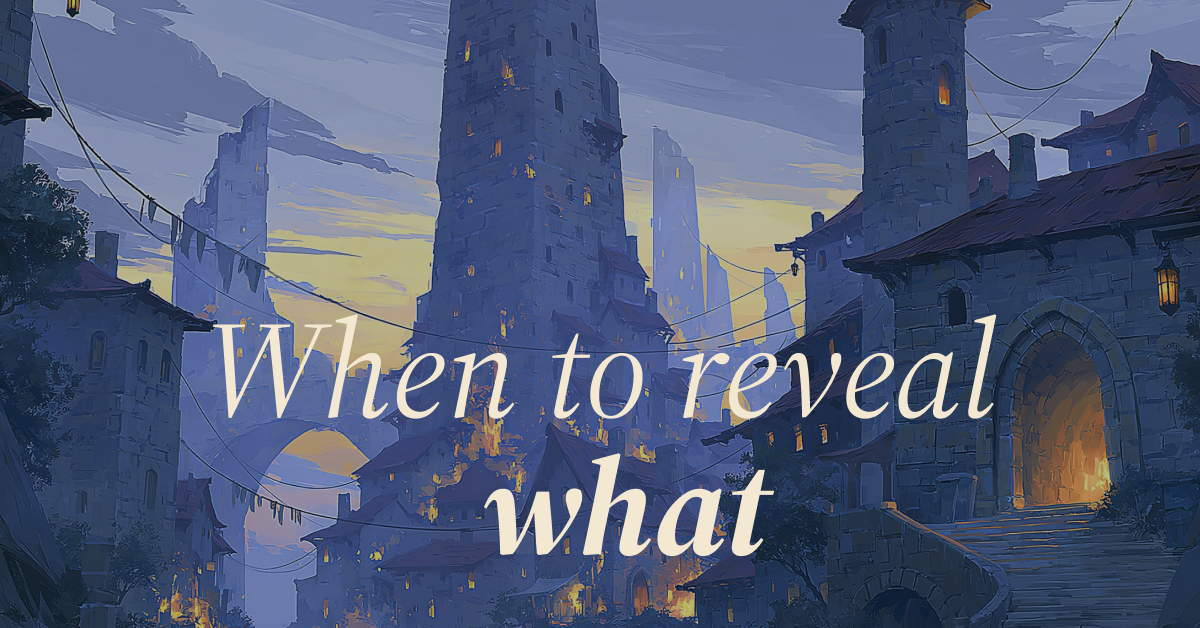
Or take a city that has been discussed for ten chapters before the protagonist finally arrives. Showing the city when the reader enters it can make the illustration feel like part of the arrival itself.
The same principle applies to objects. An ancient sword can remain undescribed beyond what the story requires. When its history finally becomes important, an illustration can reveal its design, markings and physical details. The visual reveal and the narrative reveal reinforce each other.
That is a very different use of artwork from simply placing a picture beside chapter three because there happened to be one available.
Pacing Visual Cues
There is a reason stories don’t explain everything immediately. Information needs room to work.
If every character, location, creature, object and faction is fully visualized before the reader has encountered them, some of the discovery disappears. The reader has been given the answer before they’ve had a chance to wonder about the question.
This doesn’t mean authors should deliberately hide everything either. It means visual information should earn its timing. Pacing of visual information will be crucial for your story's success on Quibble when worldbuilding tools fully roll out.
Why You Should Invest In Book Art
AI is lowering the cost and time required to produce written fiction and visual material. That means the supply of creative work is growing much faster than any individual reader’s available attention.
Authors will therefore need to give readers reasons to stay with a particular story. That doesn’t mean adding artwork for the sake of adding artwork. It means thinking about the reading experience as something authors can deliberately shape.
Should you hire an artist? That depends on your goals, but an artist - through an outside perspective - can help you notice details about your own world that you hadn’t thought about yourself. After all, everyone can benefit from a sounding board.
Three Useful Questions You Can Ask
For each visual element, there are three useful questions:
What?
What part of the world, character, object or story are you showing?
Why?
What does the reader gain from seeing it?
When?
At what point in the story does seeing it create the most value?
Sometimes the answer will be immediately. Sometimes it will be twenty chapters later. And sometimes the answer will be: don’t show it all.